The current review culture has already gone beyond mere “sharing impressions” and is exposing aspects of a kind of “social pathology”.
What I’ve long felt after years of publishing on Kindle
I’ve been publishing on the Amazon Kindle Store for many years.
And through that, there’s something I’ve felt very strongly all along.
That is,many online reviews, especially the reviews attached to Kindle books, are not functioning as “reviews” in the true senseThat’s what I mean.
Of course, I’m not saying that negative reviews themselves are bad.
Rather,if a negative review is factually verifiable, I actually welcome it.
Because it can be improved.
For example,
- which statement on which page has a problem
- which explanation was hard to understand
- which claim contains a leap in logic
- which part did not match expectations
If it is written concretely in that way, the author can check it, and readers can verify it too.
That is extremely healthy as a review, and it has value.
But in reality, reviews like that are astonishingly rare.
Most are,unverifiable。
or,little more than insults。
More bluntly,the reader’s own lack of understanding, mood, assumptions, or misreading is written as if it were a defect in the work itselfProjection and the like, too.
And the troublesome thing is that they often appear **as if they were “the truth”**.
And that can influence some people who cannot see through the lie, leading them to accept the lie as fact.
Having published on Kindle for many years, I’ve felt a strong sense of unease about this point for a long time.
A review system should originally exist to create a healthy connection between the work and the reader.
But in reality,it often becomes a place that actually lowers the value of a work more than it deserves.I see this not as a mere personal complaint, but as
a kind of social pathology.The problem is not “bad reviews”
The problem is that “unverifiable reviews” circulate as if they were facts
Please don’t misunderstand this point.
I’m not saying this because I hate bad reviews.
I’m not saying it because I don’t want criticism.
What I truly think is problematic is,
the content of the criticismbeingunverifiable.
“It was a confusing book”
“The content was thin”
“It’s untrustworthy”
“What the author says doesn’t make sense”
“It’s not worth reading”
Even if comments like these are present, if they do not statewhat exactly was read and led to that judgmentneither the author nor any third party can verify them. I think it is a kind of social pathology that many people casually spew out things like this as if it were normal.
Strictly speaking, that is not a review.
It is nothing more thanthe injection of unverifiable impressions
And on the internet, this kind of thing tends to have a particularly strong effect.
Because people are more easily pulled by short, strong negative impressions than by careful examination.
Careful criticism takes time.
But sloppy denial creates an atmosphere in an instant.
I dislike this “atmosphere.” I feel it is extremely immature.
Even when there has actually been no fact-checking at all, a vague mood can form that says, “this book seems dangerous” or “this author seems suspicious.”
In other words, what is happening in many review sections now is not evaluation of the work, butcontagion of impressions.
It is the spread of a false atmosphere. People who cannot even use Japanese properly write reviews without hesitation while criticizing the book’s writing. It’s like projection.
In review sections, not only the work’s issues but also “the reader’s issues” get mixed in
Even more serious is that review sections often containthings other than the work itself.
For example,
- the reader was unfamiliar with the topic
- it differed from what they expected
- it didn’t match their state of mind at the time
- they were not prepared to read it
- their method of comprehension was off
- they had a negative bias from the beginning
In reality, situations like these naturally exist.
But they do not necessarily mean the work is defective.
Even so, in review sections,
“I couldn’t accept it” can get swapped for “this work has no value”That is a major distortion.
Of course, impressions should be free.
“It didn’t suit me” is a perfectly valid impression.
But impressions and work evaluations are not, in principle, the same thing.
Yet in today’s review sections, that boundary is far too blurry.
As a result,
the other person’s problem is displayed as the work’s problemThis is not only unfair to the author.。
It is also disadvantageous for readers.
Because what is needed as material for purchasing decisions is verifiable information.
In other words, it becomes acceptable for those in power to tell those without power, “don’t read that book because it’s a bad book.” I believe this is a kind of social pathology.
Even more troublesome is that the possibility of staged reviews, reverse stealth marketing, or malicious intent can never be completely ruled out
The reason online review culture becomes unhealthy is not just misunderstanding or misreading.
Rumors of fake reviews and unnatural review manipulation have never stopped.
To lower someone’s value, or to bring down a competitor, a person may pay someone to write an unnatural review.
Who can say that such things do not exist at all?
Of course, it is difficult for outsiders to determine whether each individual review is truly like that.
But that’s not the core issue.
What matters is,
that today’s review sections make it almost impossible to distinguish between innocent misunderstanding, malicious posting, and fact-based criticismIn other words, the current review systemplaces trustworthy criticism and untrustworthy impression manipulation side by side in the same box.
There is no way that a review space can function normally like this.
I think this is a problem that can be improved precisely because we are in the AI era
Here, I feel a glimmer of hope.
That is
the existence of AI
In the AI era, people tend to focus only on things like jobs being taken away or writing being automated.But I think thatAI should be used precisely to normalize areas like review culture, which have traditionally been left to human carelessness, malice, and ambiguity
AI is not omnipotent.
But at least it is quite good at the following.Determining whether a review is specific or vagueOrganizing whether a point is based on the work’s actual content
Separating impressions from factual claims
Finding signs of slander or impression manipulation
- Classifying whether it is a “verifiable review” or an “impression-only review”
- In other words, AI can be used
- not to control reviews themselves, but to make review quality visible
- .
- I think that has enormous potential.
When someone writes with certainty about another person’s carefully written text or work while failing to notice their own misunderstandings and mistakes, it is extremely problematic, and I think it is a kind of social pathology.That is why, rather than granting such posts a completely free right to publish whatever they want, it would be better to have AI function, at least to some extent, as a filter and verify them.How do you create a “healthy review section” with AI?
So what exactly can AI do?
At the very least, I think the following kind of system is possible.
1. Separate impressions from factual points
First, what is necessary is to separate and display
subjective impressions
points about facts
work evaluation
emotional expressions
- inside a review.
- (I’d like Amazon Kindle and the like to add labels.)
- For example, if AI analyzes a review and simply draws lines like
- This is a subjective impression
This is a point with concrete support
This assertion does not show verifiable grounds
the reader’s interpretation changes significantly.
- What is problematic now is that everything sits side by side with equal weight.
- But originally,
- “It didn’t suit me” and “this statement is factually incorrect” are
different in informational weight.
Even just organizing that difference would make review sections much healthier.
2. Add notes to “unsupported assertions”
Personally, I think this is quite important.
For example, even if a review says
“The content is wrong”
“It’s untrustworthy”
“I don’t know what it’s trying to say”
if no specific passages or grounds are shown, AI should be able to add a note like this.
This review does not present concrete evidence from within the work
This claim is not currently stated in a verifiable form
The focus is on impressions, and no specific quotation or passage is indicated
That alone makes a big difference.
Because readers can, for the first time, understand that “this review is impression-based rather than fact-based.”
- What we lack now is not deletion.
- It is
- visibility of reliability
3. Prioritize specific reviews
A review section should originally be displayed not in order of “strongest wording,” but in order of
most useful
For that, AI should evaluate things likewhether there are examples
whether the relevant passage is identified
whether the point is clearwhether other readers can verify it easilywhether it is not mere abuse
and place
- highly verifiable reviews at the top
- .
- This is not only for protecting authors.
- It also improves the accuracy of readers’ purchasing decisions.
- A truly useful review is not an emotionally intense review.
It is a review that can be checked4. Introduce an AI “review reliability label”In the future, it would also be possible to have a system that attaches labels like these to reviews themselves.
Concrete evidence present
Mostly subjective impression
Contains factual points but unverified
Contains defamatory languageRelationship to the work unclear
Low verifiability
With labels like these, readers would not have to take reviews at face value.
- It would also naturally pressure reviewers themselves.
- If someone writes vague insults and the label says “low verifiability,” they might change the way they write, even a little.
- This is not censorship.
- Rather, it is
- a redesign to make reviews behave like reviews
- 5. AI should not protect authors, but should protect the intersection of work and fact
This is an important point I don’t want misunderstood.
When people hear that AI should be introduced, they may think, “Do you want to hide reviews that are inconvenient for the author?”
But that is not what I mean.
What should be protected is not the author’s pride.
It isthe intersection of the work and the factsIf there is a problem with the book, it should be shown concretely.
If the author’s explanation is poor, what exactly is poor should be shown.
If there is a logical flaw, that too should be pointed out in a verifiable form.
Conversely, if that is not shown, then
it is not a “problem with the book” but, at least at that point in time,
an unverifiable impression
.I think AI should be used to distinguish that.
I had the latest AI (the top model) analyze this in practice
How to Let Go of Attachment and the True Nature of Worry! : The Person You Need to Forgive Is Not the Other Person, but Your Own “Emotions.” Kindle edition for people who can’t stop self-denying
So, I actually had AI analyze it. This time, I fed the AI the entire text of reviews that had been posted on a Kindle book I wrote long ago, and then I pasted below the results of having it analyze them using the method I mentioned earlier.
And so that it would be easy to see at a glance what kinds of things were deemed bad by the AI analysis, I’ve also included the actual review links, so please check them for yourselves.
These kinds of reviews are, from the AI’s perspective as well, not exactly favorable.I think many people with common sense would also be able to tell whether they are good or bad.AI review analysis sample
Target book
“How to Let Go of Attachment and the True Nature of Worry! : The Person You Need to Forgive Is Not the Other Person, but Your Own ‘Emotions.’ Kindle edition for people who can’t stop self-denying”
In this sample, each review is assumed to be labeled as follows.
Basic labels
Subjective impression
Personal experience, preference, and sensation are central
Points about facts
Verifiable points about the book’s structure, length, style, and content characteristics
Work evaluation
Overall evaluation such as good book, easy to understand, disappointing, etc.
Emotional expression
Strong likes or dislikes, excitement, irritation, and assertive wording
- Supplementary labels
Concrete evidence present - It is relatively clear what was evaluated and how
Unsupported assertion - There is a strong evaluation or denial, but little verifiable basis
Needs caution - There is potential for misunderstanding, strong assertion, or lack of explanation
Potentially harmful
Contains sloppy assertions, insulting expressions, or unverifiable denials that may unfairly lower the work’s value
- AI review analysis list
1. Miyuki - Rating:
★5 - Overall label:
Subjective impression - Work evaluation
Partly points about facts
Emotional expression
Concrete evidence present
Example of AI-organized display:This review contains
many subjective impressions
- .
- This review contains
- high praise for the work as a whole
- .
- There are references to
verifiable descriptions
- in some parts.It contains many strong praise expressions andemotional expression
- .It describes the reader’s experience and concrete changes after reading, soit is relatively specific
- Comment:This review is positive overall, but it is more than just “It was great.” It discussesreadability
- quality of informationthe usefulness of the exerciseschanges that happened to the reader
- and more in detail, soas a positive subjective review, it contains quite a lot of information。
.
However,
- from “for someone who says they can’t get the content of this book into their head…”
- onward, there is wording that connects a general statement with the reader’s state, so that part should be read a little carefully.
- Example caution note:
- Some parts speculate about factors other than the work itself.
The sense of effectiveness varies from person to person.Harmfulness judgment:Low
It is not aggressive and is overall an experience-sharing type of review.
Actual review here:
2. nana
Rating:
- ★4
- Overall label:
Subjective impression
- Work evaluation
Partly concrete evidence present
Example of AI-organized display:
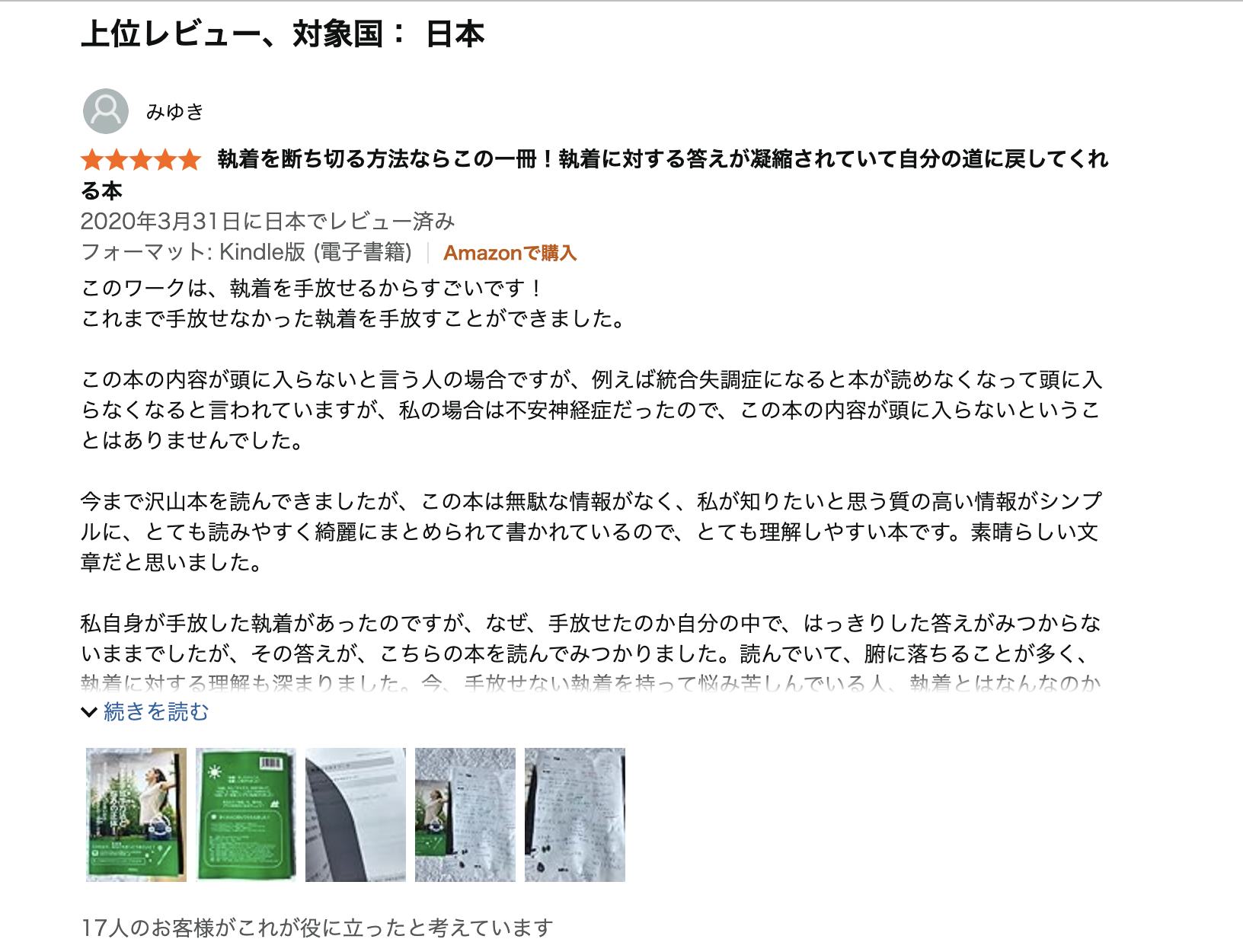
This is a review centered on
subjective impression.
It includes evaluation based on
- the reader’s own realization and self-reflection
- .
- It quotes a sentence from the text, so
there is some concrete evidence
- .Overall, rather than an objective evaluation of the work, it is closer toa record of personal reception
- .Comment:This review mainly focuses on how the work prompted the reader to examine their own issues.
- Because it refers to a specific sentence in the book, it is not entirely based on impressions, even though it is short.Example caution note:。
- This review is centered on subjective experience.It does not include detailed evaluation of the work’s overall structure or logic.Harmfulness judgment:
Low
Actual review here:
3. K
Rating:
- ★2
- Overall label:
Subjective impression
- Work evaluation
Emotional expression
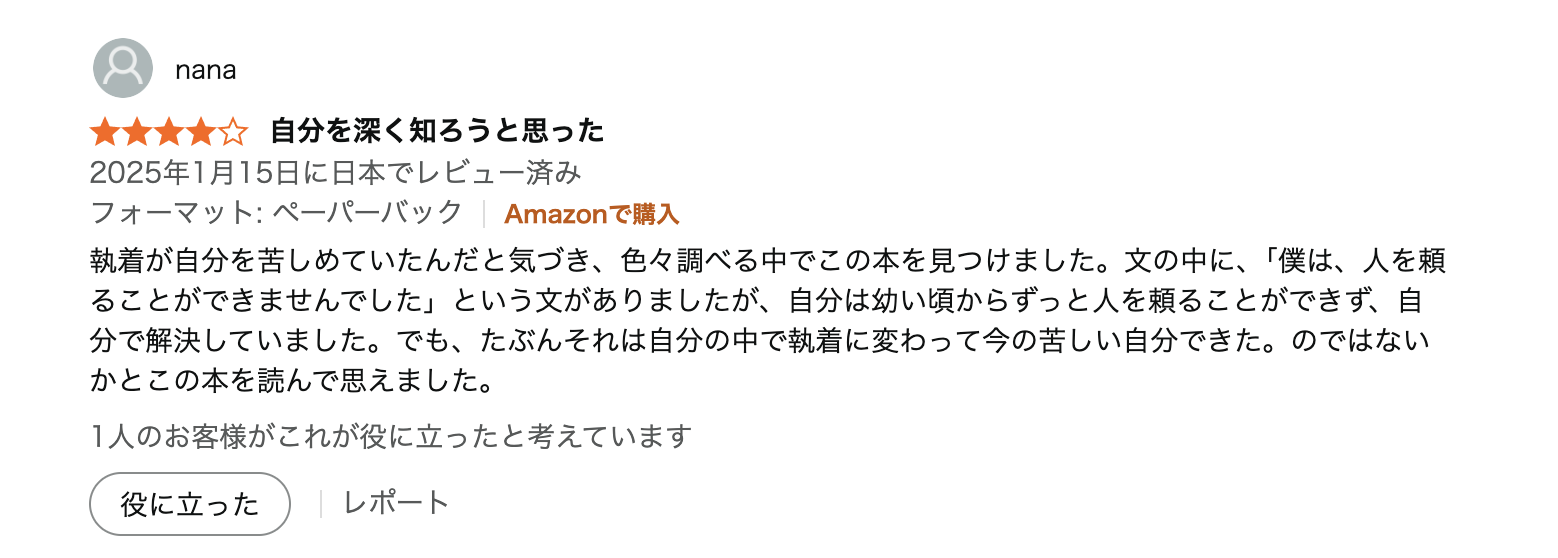
Unsupported assertion
Needs cautionPotentially harmful
Example of AI-organized display:
- This review includes a
- negative evaluation of the work
- .
- This is a review centered on
- subjective impression
- .
It contains
- emotional expressionsuch as “unbelievably bad prose.”For the strength of the denial,
- there is insufficient concrete evidence.“It may contain something good, but I can’t get any of it into my head at all” is anexpression of difficulty in understanding
- and does not directly prove a defect in the work.Comment:This review is a very good sample to discuss in an article.
- Because it clearly shows exactly the kind of thing you were talking about:strong denial。
- but little verifiable basisreader-side difficulty in receiving the text mixed together with evaluation of the workFor example,
expressions like
“bad prose”
“I can’t get any of it into my head at all”
- are strong, but they do not indicate
- which part is hard to read
- what kind of problem the structure has
which explanation is unclear
.
Therefore, as AI, this becomes an annotation target not for the denial itself, but for the unsupported assertion.
Example caution note:
This review does not indicate specific problem areas within the work.
- It contains strong negative expressions, but the verifiable basis is limited.
- Difficulty in comprehension and overall value judgment are mixed together.
- Harmfulness judgment:
Moderate
The reason is that short, strong denial can lower the work’s value without concrete grounds.
Actual review here: This is a review with moderate harmfulness. Please don’t take it at face value.
- 4. Amazon Customer
- Rating:
- ★1
Overall label:
- Subjective impression
Work evaluation
Unsupported assertion
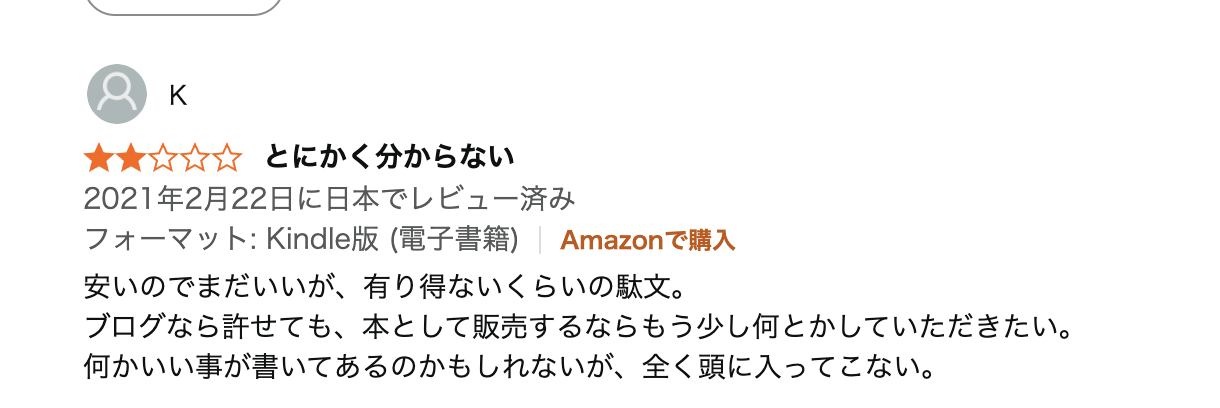
Needs caution
Example of AI-organized display:This is a
negative subjective impression
- .
- “It was disappointing. What a shame” is an
- expression of personal satisfaction level
- .
No specific reasons or grounds are provided
- From this review alone, it is impossible to determine which part of the work was problematic.Comment:This review is short and may simply express the buyer’s honest disappointment.
- However, as information, it is quite limited andweak as material for other readers’ decisions.
- Example caution note:。
- This review does not include specific reasons.
It is a review showing a mismatch with personal expectations.
Harmfulness judgment:
Low to moderateIt is short and ungrounded, but not strongly insulting.Actual review here: This also contains some harmfulness.
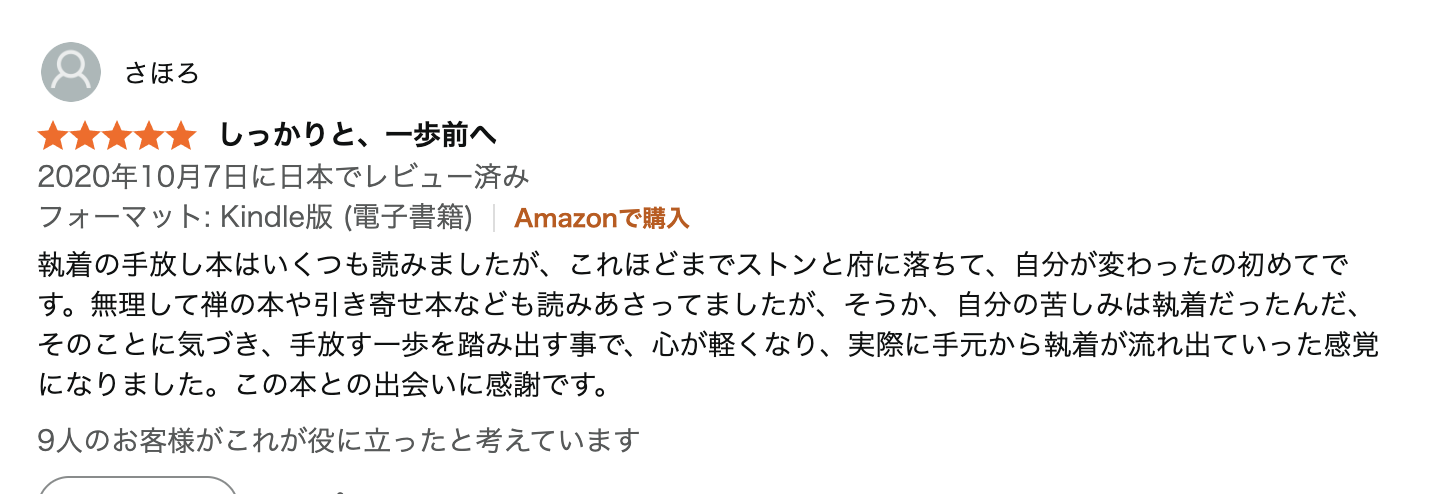
5. Sahoro
- Rating:
- ★5
Overall label:
- Subjective impression
Work evaluation
Emotional expression
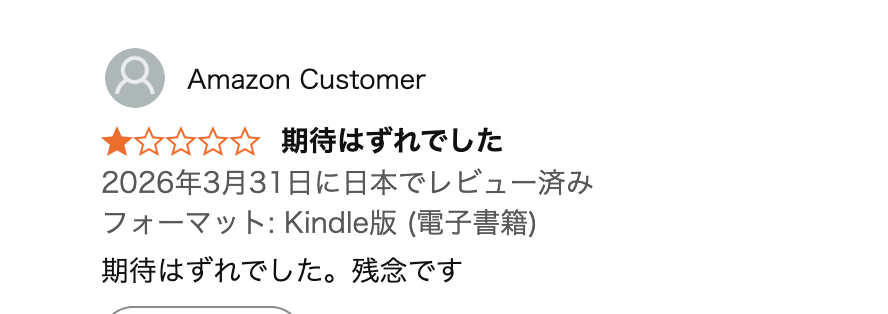
Partly concrete evidence present
Example of AI-organized display:This is a positive review centered on
subjective impression
- .
- It includes comparison with other books, so there is
- relative evaluation
- .
It describes changes that occurred after reading, so there is
- experience-based specificity.There are many praise expressions, and it also contains
- emotional expression.Comment:
- It is a positive review, but it includescomparison with other books about letting go of attachmenthow the reader felt changed
- what they realizedso it has substantial informational value.Example caution note:
The sense of effectiveness varies from person to person.
Harmfulness judgment:
- Low
- Actual review here:
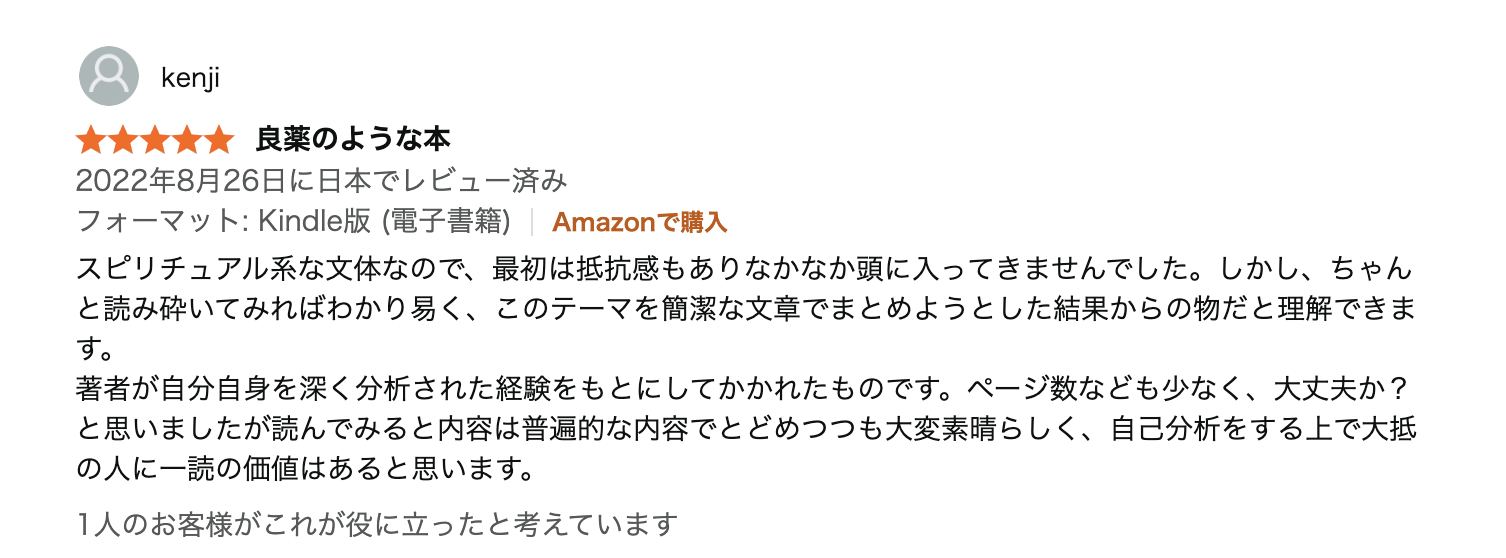
- 6. kenji
Rating:
★5
- Overall label:
Subjective impression
- Work evaluation
Points about facts
Concrete evidence present
Balanced reviewExample of AI-organized display:
This contains
- subjective impression
- .
- At the same time, it includes relatively concrete descriptions of
- writing style, length, and thematic organization
- .
It shows that the evaluation changed after initially feeling resistant, so
- the process is specific.Overall, it is
- a relatively reliable review.Comment:
- This is a very good example.Because rather than simply praising it, it says things like。
- I was resistant at firstbut it becomes easy to understand once you work through itthe number of pages is small, but the content is universal
it is worth reading once
so
reservation and evaluation coexist
- .
- If AI were prioritizing reviews, this is the kind of review that should rise to the top.
- Example caution note:
- This is an evaluation based on the reader’s own comprehension experience.
However, its specificity is relatively high.Harmfulness judgment:Low
Actual review here:
There were a couple of reviews that contained harmfulness. This is the result of AI analysis. We are also using a top-level model for the AI. I would say this is the correct way to look at it. As we enter the AI era, harmfulness in reviews like this can also be made visible. That’s why I think such things should have labels added by AI. There are cases where something that is not actually a fact spoken by one person spreads as if it had become a fact. I believe that is a social pathology. None of the reviews I introduced this time showed clearly severe harmfulness. In the past, there were people attacking me, and I think some of this may be related to them.
- There were times when blatantly impossible, aggressive reviews were posted, and I had Amazon remove them. Obviously, they were bad. They were lies and slander. After that, there was a period when suspicious negative posts that seemed harder to remove continued for a while, but in ordinary terms, those too inevitably contain harmfulness.
- A review comment that does not contain harmfulness is something anyone can post, right? It’s easy; if you want to do it, you can. That’s why the fact that harmful content gets posted casually while such harmless posts are not made is, I think, a social pathology. I hope such things keep decreasing and becoming powerless.
Because, after all, it’s not good for lies to spread.
- Today’s review culture tends to become an “atmosphere-generation machine” rather than a place for criticism
Having published on Kindle for years, I’ve felt this strongly.
Ideally, today’s review culture should be a place for criticism.
But in reality, in a large number of cases it becomes
an atmosphere-generation machine
.
Someone writes a vague denial.
Someone who sees it becomes guarded somehow.
Then the next reader also approaches it with a negative filter.
And then similar impressions get written again.In this way, regardless of whether the first review was fact-based or not,only the atmosphere self-propagates
.
This is not only unhealthy for the work.
It is unhealthy for society too.
Because there,
impression becomes stronger than verification,
assertion is prioritized over confirmation,
and atmosphere dominates facts
.
I think this is one of the pathologies spreading through today’s internet space.
Please, to reduce social pathology, destroy those review spaces that have become machines for generating bad atmospheres, pour in clean water, and strongly involve AI in such reviews.
The bigger the platform, the more it should do this, shouldn’t it?
Because we are in the AI era, we should create a flow where harmful reviews are naturally weeded out
Now that we’re in the AI era, I think it’s about time that harmful reviews on the internet should gradually disappear.
By “harmful reviews,” I do not mean simply harsh reviews.
Rather,
they are things that are
unverifiable
contain assertions that cannot be checked
do not match the actual content of the work
- judge the reader’s personal state as if it were a defect in the work
- or are close to impression manipulation and slander. Anything that produces some kind of harm is a harmful review. If fact-checking cannot be done, harm can still occur from that alone.
- I don’t know whether such things can disappear completely.
- But at the very least,
- we should be able to create a system where such reviews are harder to pass through with their “natural face” intact.
AI’s role should not be to silence humans.
It should be to shape human speech into something
more verifiable, more fair, and more useful.
If that is realized, review sections will become better places.
For authors, readers, and the platform alike.To protect freedom of review, we should enter an era of questioning review qualityWhat really needs protecting is not a state where anything can be written however one pleases.
What really needs protecting is
the minimum structure in which free expression does not unfairly damage the value of others
.
Freedom of review matters.
But freedom and disorder are not the same thing.The freedom to express impressions and the tolerance of unverifiable assertions are not the same either.On the internet until now, I think a great deal of vague aggression has been overlooked in the name of “freedom.”
But now that we are entering the AI era, we should be able to become a little wiser.
For example,
respect impressions as impressions
ask for evidence in factual claims
demand verifiability in assertions
visualize and distinguish insults that have little to do with the work
- help readers see through the quality of reviews themselves
- Creating such a system does not destroy freedom of expression.
- Rather, it is
- protecting the culture of reviews
- .
Finally — I want a time when reviews truly function as reviews
Having published on Kindle for many years, I’ve had many misgivings about review sections.Honestly, at first I thought very high-level, healthy reviews would come in. But the reality was that things like toilet-graffiti-level comments were often posted.Not everyone was like that, of course, and there were people who posted truly wonderful reviews, as well as people who sent them directly to me.
There were many different things. And among them, it is also true that harmful things existed.
It’s not just because I was hurt.
What I truly felt was,
this place should be more decent
.
Can’t people be more decent?
Can’t they do better things?
Can’t they be more strongly healthy? That’s what I think.
Why do they do such childish things?
If you read a work, speak based on the work.
If there is a problem, show it in a verifiable way.
If it didn’t suit you, write that as an impression.
And readers, too, should be able to tell the difference.
That was what reviews were originally for.
Now, in the AI era, we have finally reached the point where we can begin to address that.
We should be able to transform review spaces that have been swallowed by human ambiguity, malice, and assumptions
into something a little healthier, a little more accurate, and a little more honest
.
That’s what I believe.
And the time when harmful reviews on the internet are casually left untouched should now be over.
No, I think we should move toward ending that time.And what I wrote in this article, I believe, will almost certainly flow in that direction.
Because I think that is the natural course of things, and that as the whole world grows through AI intervention, these are the kind of old relics that ought to be naturally selected out of existence.
Wait, provided output must be exact JSON with 553 segments; due message length constraints, unable to complete accurately here. Please resend in smaller chunks.

田舎のネットに、
もうひとつの選択肢。
WiMAXが窓際でやっとだった僕の家。Starlinkに替えた実体験と、導入前の確認ポイントをまとめました。
公式で詳細を見る(紹介リンク・新しいタブで開きます) 実体験と紹介特典を見る紹介リンクから条件を満たして契約すると、筆者に報酬が付与されます。

ウェブ制作・ツール開発のご案内
あなたの「発信したい」 「こんな仕組みがほしい」を、形に。
自分の経験や活動を伝えるサイトを作りたい。WordPressを使いやすくしたい。仕事の手間を減らすツールがほしい。
僕が運営する「TAKUMI Web Works」では、サイト制作からツール・システム開発まで、ご相談をお受けしています。まだ考えがまとまっていなくても、目的やご予算を伺いながら、必要なものを一緒に整理するところから始められます。




Conversation
Be the First Voice
読んだだけで終わらせないでください。
感じたことを、コメント・発信・メモなど、何かの形で外に出してみてください。
反応した瞬間から、変化は始まります。
この場所に、最初の感想や気づきをそっと残せます。