Right now, the stigma around NPD is being recognized as an international problem
The stigma surrounding narcissistic personality disorder, or NPD, is now beginning to be recognized internationally as a serious issue. A 2025 study explains that stigma toward NPD can become a major barrier to diagnosis and treatment, and it is being treated not as a mere online argument, but as a social problem that actually prevents support and understanding. In addition, the American Psychiatric Association explains that stigma and discrimination around mental illness can genuinely harm people and obstruct access to medical care and support.
What is more, this problem does not end with misunderstandings among the general public. A 2025 study also suggests that even clinicians may have emotions such as anger or irritation toward people involved with NPD, and that these feelings can distort assessment. In other words, NPD is becoming understood as a topic that can distort not only the people directly affected, but also the perceptions of those who observe and support them. The prejudice surrounding NPD is therefore not something outside society; it is a deeply rooted issue that can enter even the front lines of care.
NPD is not the name of a “bad person” or a “demon”
First, one thing must be made absolutely clear. NPD is not the name of a “bad person.” The American Psychiatric Association describes NPD as a complex diagnostic concept that requires careful handling, involving traits such as grandiosity, a strong need for admiration, and difficulty with empathy. And the casual use of the word “narcissist” in everyday speech is not the same as clinical NPD.
Likewise, the support organization NAMI says that NPD should be understood not as a simple “personality of malicious intent,” but as an issue related to the self, and that stigma drives people away from support. In other words, something that is originally complex, varies from person to person, and may be tied to suffering and vulnerability is often reduced in society to nothing more than a “label for a terrible person.”
First, society as a whole is made to see NPD as much worse than it really is
What I think matters most here is that society as a whole is shown NPD as something far worse, more frightening, and more dangerous than it is in its clinical understanding.
In other words, many people are given a distorted image before they ever develop an accurate understanding. The moment they hear the word NPD, impressions like “dangerous,” “evil,” or “someone to avoid” come to mind. That is not calm understanding; it is a very strong preconception. Research on stigma toward NPD also confirms that NPD tends to be viewed extremely negatively in society.
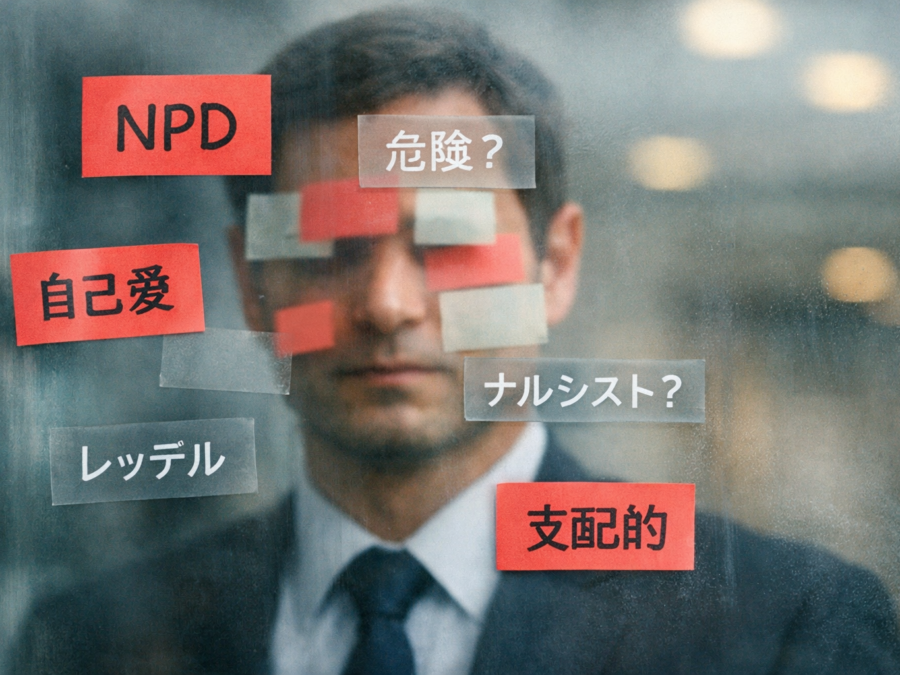
Society first creates a “bad ghost,” then sticks it onto a person
Put simply, I think what society does is first clothe the word NPD in an image like a “bad ghost,” and then stick that finished image onto a person.
First a terrifying image is created. Then that image is attached to someone you do not like. As a result, the person’s complexity, background, and original qualities become hard to see. What you are looking at is not the person themself, but the frightening story that was created beforehand. Once the label comes first, people are more likely to see that person as worse, more dangerous, and more simplistic than the facts would justify. This is precisely how stigma works.
The label can be used both on individuals and on politicians
The danger of this kind of labeling is not limited to interpersonal relationships. In politics as well, psychiatric language is sometimes used as a convenient tool to make it seem as though one has explained the other side.
In principle, politicians should be criticized for policy, accountability, governing ability, use of power, and ethics. But when the discussion shifts toward “Is this person NPD?” or “Is this pathological narcissism?”, debate about policy and responsibility is replaced by a story that pathologizes the entire person. The American Psychiatric Association’s maintenance of the Goldwater Rule, which considers it unethical to offer professional opinions about public figures without examination or consent, exists precisely because this danger is real.
In reality, “NPD-style labeling” of politicians has happened repeatedly
This is not an abstract argument. In practice, language using NPD or similar narcissism labels for politicians and national leaders has appeared again and again.
In the United States, around Donald Trump, language such as “narcissism” and “malignant narcissism” spread widely in the worlds of psychiatry and political commentary. In 2017, a book discussing Trump’s mental state caused major debate, and Lawfare treated it as a representative example of the controversy surrounding the Goldwater Rule. More recently as well, public letters and reports have continued to describe Trump as having “malignant narcissism.” What matters here is not diagnosing Trump, but the fact that such labeling discourse has actually circulated in political space.
Japan is not unrelated to this structure either. For example, a 2014 Japan Times essay described former Prime Minister Shinzo Abe as a symbol of “immature narcissism.” What I want to say here is not that I am diagnosing former Prime Minister Abe with anything. Rather, the point is that there has been a real tendency to use psychology- or psychiatry-like language on actual politicians as a way to shape impressions and simplify their personalities.
That is why this issue matters so much for right-leaning conservatives
This is the point I particularly want to emphasize. Stopping the demonization of the NPD label has considerable significance even for right-leaning conservatives.
In real political space, politicians with strong self-assertion, authority, a sense of nation, emphasis on order, confrontational rhetoric, or strong leadership styles are often more likely to be described with psychological labels such as “narcissist” or “pathological narcissism.” So the more NPD is strongly demonized in society, the more right-leaning or conservative politicians and commentators are drawn away from policy and argument and into talk about personality pathology. Recent debates around the Goldwater Rule have also criticized the political misuse of psychiatric terms during the Trump era as something one-sided and as a form of politics that can destroy individuals.
In short, reducing the demonization of the NPD label works in the direction of weakening the “neutralization by psychiatric labeling” that is often directed at the right and at conservatives. It makes it easier to bring discussion back to policy, responsibility, explanation, and governance rather than speculation about diagnoses. In this sense, addressing this issue has a very practical significance for right-leaning conservatives, not just a moral one.
Labels can amplify the anger and hatred of third parties
What I find especially dangerous about this issue is that a demonized label can move not only the person being labeled, but also the emotions of third parties around them.
If someone is repeatedly presented as “dangerous,” “abnormal,” or “pathological,” it is not surprising that more people will begin to see that person as scarier and more hateful than the facts would support. Of course, one cannot and should not claim that a particular label caused a specific incident. But stigma and labeling can distort people’s perceptions and intensify anger and fear, and that is consistent with stigma research on mental illness in general.
So this issue does not end as a mere problem of rude language. It carries the risk of functioning as a device that inflames hostility and disgust in third parties. When aimed at politicians, it can intensify social division and emotional polarization. I think more people should be aware of that.
Even so, the essence of this issue is not political advantage
That said, one thing must absolutely not be shifted. I do think it is true that this issue has meaning for right-leaning conservatives. But that is not the center of the matter.
What should be placed at the center is the suffering of the people involved. In a society where the word NPD is demonized, people who actually live with these traits or this suffering are more likely to be seen from the start as “bad people,” “dangerous people,” or “people to avoid.” As a result, they become less able to ask for help, less likely to be understood, and more likely to drift away from support. Research on stigma toward NPD also points to stigma as a central barrier to diagnosis and treatment.
In other words, even if there is political utility, it is only secondary. The starting point for addressing this issue must be to make the lives of the people actually suffering from demonization a little easier. If we drift away from that, anti-stigma arguments themselves become yet another political tool.
Conclusion
The stigma around NPD is now beginning to be recognized as a problem internationally. And it is not only a matter of misunderstandings among the general public, but also a matter involving bias and difficulty on the part of professionals. If society first shows NPD as something far worse than it really is, and then sticks that demonized label onto people, they will appear worse than they are both to individuals and to politicians. When that happens, anger, disgust, and fear are also more likely to be amplified.
That is why stopping the demonization of the NPD label matters even for right-leaning conservatives. In practice, politicians and commentators on the right and among conservatives are more likely to be pulled into talk of personality pathology. But in the end, what must be protected is not a political position. What must be protected is the human heart. Easing the suffering of those who are being demonized, misunderstood, and made less able to connect with support—that, I think, is the most important center of this issue.
Note
This article does not make psychiatric diagnoses of any specific real person. The references to politicians in the text are meant to describe the existence of such labeling and commentary as public discourse, and do not claim that the individuals concerned actually meet any particular diagnosis. The American Psychiatric Association states that offering professional opinions about public figures without examination and proper permission is unethical.
Some political rhetoric has a way of demonizing specific individuals with psychiatric labels and spreading that impression to third parties, making it easier to mobilize hostility and disgust.
In that sense, the demonization of NPD can harm not only the people directly affected, but also become fertile ground for political incitement and proxy attacks.
Addendum: the problem of labels affects not only those involved, but politics as a whole
One thing I want to add here is that this problem is by no means limited to the single label NPD.
In politics, there are repeated cases in which anonymous slander, image manipulation, labels that cast someone as dangerous, and simplified portrayals of personality are directed at a person over and over again. And this is not always done with the same words. Sometimes it is framed with a psychiatric label like NPD, and sometimes it spreads through language that simply makes someone seem like a “dangerous person” or an “abnormal person.”
What matters is not the name of the label itself, but its structure.
That is, the structure of making someone into a “being to fear” or a “being to despise” rather than letting facts and policies speak, and thereby moving the anger, distrust, and hostility of third parties.
Some people may feel, when hearing this, “Does something like that really happen?” But if you look at social media and online spaces, it is not unusual to see politicians being hit with large amounts of emotionally charged language and assertions from anonymous accounts whose identities are hidden. In those spaces, I think the power of each post individually is not always the main issue; rather, repeated patterns of language gradually shift the impressions and emotions of the people who are watching.
What becomes a problem here is not a calm examination of whether the other person’s policies or statements are right or wrong, but the emergence of a flow that makes the other person appear to be a “dangerous being” or an “abnormal being.” Once that happens, discussion moves away from substance and becomes more easily driven by impressions and emotions. Politicians themselves also become more exposed to a flood of noise based on hostility and misunderstanding, separate from the policy arguments they should actually be facing.
That is why working on this structure at the political level has significant meaning.
It is not merely a matter of protecting a particular politician or favoring a particular party. If we can see through labels, anonymous attacks, image manipulation, and emotional incitement, and weaken them, politics becomes easier to move forward based more on facts and policy.
And that also matters greatly for people with NPD.
If words like NPD stop being used like a “demon tag,” people with the condition will be less likely to be treated as villains from the outset, and the suffering caused by misunderstanding and prejudice should gradually lessen. In other words, this is a case where making political debate a little healthier and easing the burden on those affected can be pursued at the same time.
Put differently, it is a two-for-one outcome.
For politics, it reduces confusion caused by unnecessary incitement and labeling, making it easier to pursue the real debate more smoothly.
For those affected, it becomes easier to reduce the pain of being further hurt by demonization and misunderstanding.
That is why I think the significance of addressing this issue is greater than many people imagine.
However, the last thing I want to confirm again is that we must not lose sight of the center of this issue.
There are certainly benefits for politics, and in the end discussion may become smoother. But that is only one result. The starting point and the center should still be the people who are suffering because of demonization and misunderstanding.
I believe it is most important not to drift away from that when thinking about this issue.
Gentle Next Step
読み終えた余韻の先で、 次の一歩を静かにつなぐ。
お問い合わせ、サービス案内、資料請求、無料相談など、記事の流れを崩さず自然に次の行動へつなげるためのCTAです。画像・文言・色はテーマ設定から自由に変更できます。

Related Articles



Conversation
Be the First Voice
読んだだけで終わらせないでください。
感じたことを、コメント・発信・メモなど、何かの形で外に出してみてください。
反応した瞬間から、変化は始まります。
この場所に、最初の感想や気づきをそっと残せます。