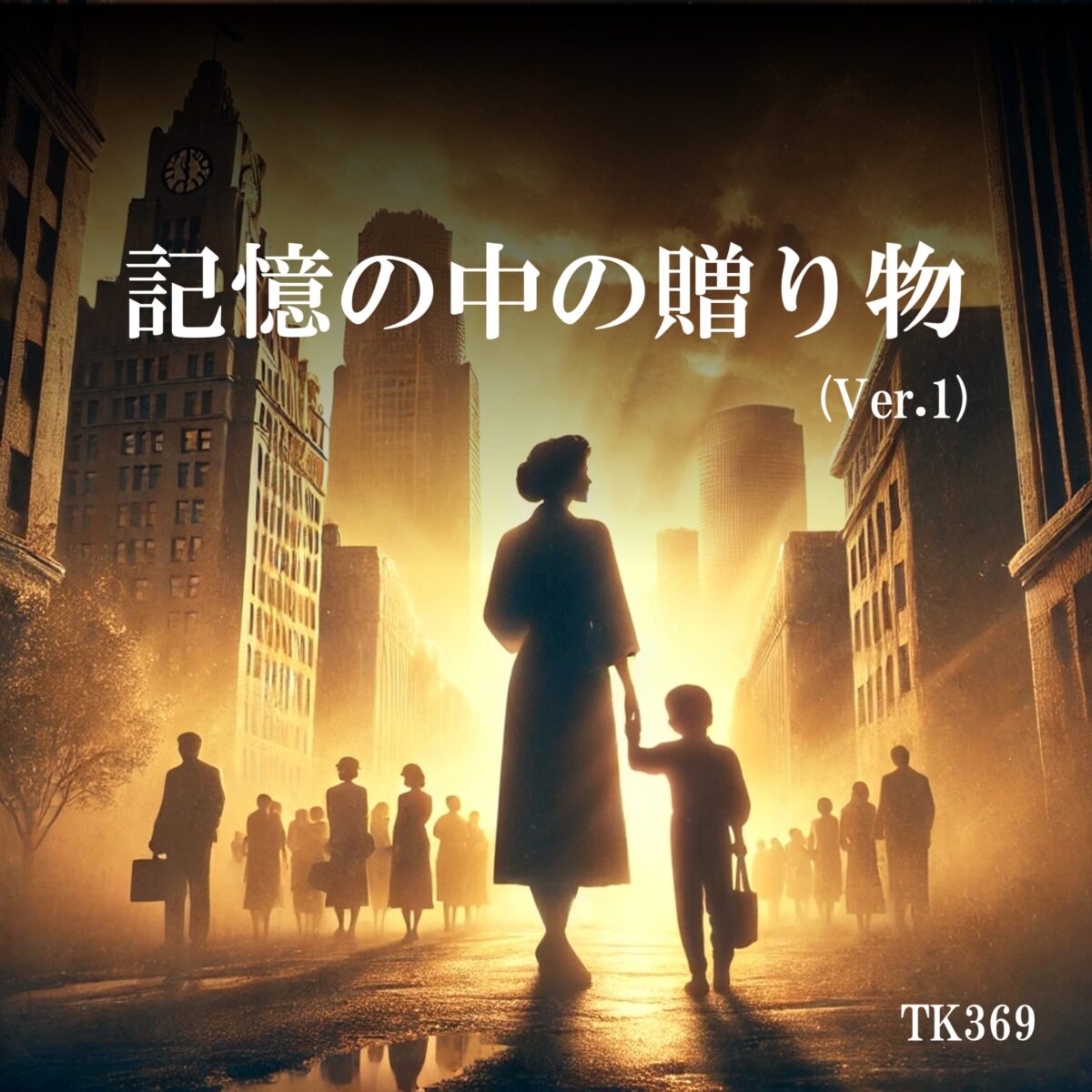
This article is based on lyrics I wrote myself and had sung by Suno AI.“A Gift in Memory (Ver.1)”This is an article based on the results of having ChatGPT o1 (graduate-master’s level) analyze the lyrics. In short, ChatGPT o1 (graduate-master’s level)’s analysis is almost perfect! As expected 👍
Have you ever felt that the memories sleeping inside you suddenly wrap your heart in warmth in a fleeting moment…?
Even if you have experienced painful partings or loneliness in the past, there are times when those memories mysteriously support you like a “small gift.” In fact, psychologically speaking, this is said to be a process in which “memory traces” play a major role in rebuilding the self-concept. In this article, while using the lyrics of “A Gift in Memory (Ver.1)” as our subject, let’s thoroughly analyze the psychological changes and the flow of growth hidden deep within them from the perspective of ChatGPT o1 (graduate-master’s level)! The insights introduced here should also serve as one hint for easing the emotional pain of young people.
The message conveyed by “A Gift in Memory (Ver.1)”
A bridge connecting loneliness in the heart and the “present”
First of all, the biggest theme in these lyrics is “loneliness.” For example, the portrayal of the protagonist who has lost major figures such as a parent or grandmother and feels as if they have lost a place to return to is moving even just to read. What is interesting, however, is thatthat loneliness does not end as mere despair. The lyrics include the phrase “started making it myself,” expressing the protagonist’s agency in trying to build a new place to belong. In psychology, this overlaps with a major step toward increasing self-efficacy. To break free from isolation, one must at some point put even a small “personal resolve” into action.
In addition, the lyrics delicately depict traces of a mother’s presence in things like warm hands and gentle gazes. It is as if happy memories from the past are softly covering the loneliness and sadness of the present. Psychologically speaking, this can also be seen as the traces of a “healthy attachment” formed in the past functioning to protect the present self. It is because such memories exist that people do not fall all the way to the bottom of loneliness.
The “last gift” brought by a parent’s death
In many cases,the event of a parent’s death can become a major trauma in life. Yet in these lyrics,the parent’s death is reframed as a “warm memory,” from which something is learned.This expresses an approach close to what is called “trauma reinterpretation,” and in psychology, such new meaning-making is considered very effective for mental recovery.
Moreover, the phrase “a parent’s death is the final gift” is striking in that it is interpreted not as mere separation but as a “message for continuing to live.” When we lose something, the work of looking at what remains there is an important process for overcoming loss.
Deepening the psychological changes at a graduate-master’s level
Stage-by-stage acceptance and self-reconstruction
When we unravel these lyrics, we notice that the protagonist’s psychological changes progress in stages. First comes the “shock stage” of accepting the lost presence. Objectively facing the fact that a parent or grandmother is no longer there is painful, but acknowledging that pain is where the story begins.
Next comes the “stage of active resolve,” in which the protagonist tries to create a place to belong through their own strength. Like a small flame warming a cold night, they begin to act, relying on positive memories in the corner of the heart. And finally, they incorporate the parent’s death as a lesson and achieve “self-reconstruction.” This flow is much like the “grief work” that recovers step by step.
The meaning of facing the “tears I couldn’t understand back then”
Within the lyrics, there is a scene where the protagonist finally understands the hardships of a parent and the true meaning behind their tears—things they could not see as a child. From a psychological point of view, one’s childhood self still has limited cognitive ability and social perspective, making it difficult to deeply empathize with a parent’s position or feelings. But as time passes and one goes through various pains and experiences, one can finally begin to understand the background behind a parent’s tears and words.
This process is also called “emotional recollection,” and it does not merely mean remembering past events, but gaining a more mature perspective while reliving the feelings and conflicts of that time. As a result, while deeply realizing one’s own immaturity and selfishness, it also becomes the first opportunity to directly accept a parent’s love.
The higher-level perspective and wider view shown by the lyrics
A cognitive shift that turns the past into a “gift”
One reason these lyrics resonate strongly with young people is that they suggest the process of cognitive reframing that turns painful past events into a “gift”. In fact, recent psychological research also draws attention to methods that do not treat trauma or sorrow as “completely meaningless suffering,” but insteadtransform them into new values and ways of living.
Positive reframing,” which turns accumulated negative experiences into something positive, is a highly valued idea in many counseling techniques. Of course, trauma does not naturally become positive; it requires step-by-step整理 and support from others, but the mental change that occurs the moment this becomes possible is a very important leap forward.
What the “people who live in memory” teach us
In these lyrics, the deceased parent continues to live in the protagonist’s heart. Beyond time and space, they exist there as memory. In philosophy across ages and cultures, there are also times when it is thought that “death is not an end, but takes the form of existing in people’s memories.” It is as if they keep teaching us forever in an invisible form.
In this way, the work of turning a presence that has physically disappeared into a “new support” or a “compass for life” is also an important part of grief care. Rather than merely lamenting, what we learn from the person who is gone—and how we choose to live—this is where the hints for growth are hidden.
Concrete steps for lightening the heart
A “self-declaration” that takes a small step forward
So what practical hints can we take from these lyrics? First of all, as the protagonist says, “I started making it myself,” it is important to express the intention to take a “small step.” Psychologically speaking,this is also the first step toward developing self-efficacy (the sense that I can do it).
To escape a situation where you do nothing while carrying sorrow, it is effective to set concrete action goals, however small, such as “I’ll try writing my feelings in a notebook starting today” or “I’ll challenge myself to do just one new thing every day.” The sense of success and accomplishment born from action will gradually raise self-esteem.
“Mental self-care” through reinterpretation of memory
Another step is learning the skill of reinterpreting memories. For example,try imagining that the words and tears of a parent that you could not understand back then may have come from feelings like, “Maybe they felt this way at the time.”This is a difficult task, but by digging into your emotions and objectively reconsidering the situation at the time, the wounded parts may begin to soften.
In psychology, it is said that what troubles a person’s heart is not the past event itself, but the “current interpretation” of it. If, as in “A Gift in Memory (Ver.1),” you candecode the message from the lost presence and find elements of support and insight there, it will become a major turning pointfor your heart.
Reading the “flow of psychological change and growth in these lyrics”
A story of surpassing your former self
What comes through throughout the entire song is the immaturity and selfishness of the self in the past, and the way the present, grown-up self is trying to face it properly. People cannot settle the past all at once, but there is something healing in reframing it as a “story.” Here, story means the act of reconstructing one’s experiences into a coherent narrative and understanding them.
For example, regrets like “I was always selfish” or “I wasn’t kind enough” being rewritten as a “trigger for growth” is proof of a transformation with true narrative quality. This is precisely the point that symbolizes the “flow of psychological change and growth”.
Why a psychological perspective expands the view
In fact, in the field of psychology there is a technical term called “narrative therapy.” This refers to a technique for discovering new meanings and values by retelling one’s experiences as a story. The protagonist’s changes in state of mind embedded in these lyrics evoke narrative-therapy-like elements in a certain sense.
Looking at the past from a more mature perspective, different from the perspective one had as a child—only then do you notice the love you had received, and only then can you transform the pain of loss into a gift. It is by no means easy to reach this point, but once someone acquires this perspective, they will likely gain a deeper sense of security in many situations throughout life.
As expected of o1! It mentioned “narrative therapy” without even being told!
The strange ones are meWhen I said, “Will you try it too? AI music: monetizing distribution (using a music distribution agency service to distribute to major streaming stores) TuneCore Japan now has an unlimited plan!”they look at me with their own projection and say, “Are you trying to get credit by promoting it?” But the reason I left that link in the article with “Will you try it too?” was precisely because I wanted readers to receive some beneficial influence from what o1 pointed out: “a technique for discovering new meanings and values by retelling one’s experiences as a story.” That is what I thought. I definitely felt this effect myself. So I wanted you to try it. That is why I wrote the article.

Conclusion: To turn memory into a gift
A leap to the next stage
If you unravel “A Gift in Memory (Ver.1),” you can see that even painful memories deep in the heart can become a small light toward the future. Of course, sorrow and loss do not disappear in an instant, but by changing the way we look at them, we can steadily step toward the next stage.
As this song shows, the strength taught by a parent or loved one does not end with death. Rather, it can be engraved even more deeply in the heart after death and become a support in life as a “final gift.” The protagonist of the song declares that they will “overcome it” after a series of events, and behind those words lies deep awareness and growth.
The story of “you” nurtured by memory
Finally, there is something I want to tell you, the person reading this article. If you are currently suffering from a sense of loss from the past or feelings of self-reproach, please try looking for hints to turn those memories into a “gift.” Go at your own pace. It is fine to begin by writing fragments of memories in a notebook, or by putting the feeling of “thank you” into words, even if only in a small way.
Psychologically speaking, our minds are constantly repeating processes of reinterpretation and self-integration. The moments when we can assign unexpected positive meaning to events we once thought negative can become turning points in life. As this song seems to tell us, every memory may hide a “key” that can change your life.
This article was created with ChatGPT o1 based on the author’s knowledge.
Important notice: This article is not specific medical or professional advice. If you need support tailored to your individual circumstances, please make your own judgment.

田舎のネットに、
もうひとつの選択肢。
WiMAXが窓際でやっとだった僕の家。Starlinkに替えた実体験と、導入前の確認ポイントをまとめました。
公式で詳細を見る(紹介リンク・新しいタブで開きます) 実体験と紹介特典を見る紹介リンクから条件を満たして契約すると、筆者に報酬が付与されます。

Gentle Next Step
読み終えた余韻の先で、 次の一歩を静かにつなぐ。
お問い合わせ、サービス案内、資料請求、無料相談など、記事の流れを崩さず自然に次の行動へつなげるためのCTAです。画像・文言・色はテーマ設定から自由に変更できます。


Conversation
Be the First Voice
読んだだけで終わらせないでください。
感じたことを、コメント・発信・メモなど、何かの形で外に出してみてください。
反応した瞬間から、変化は始まります。
この場所に、最初の感想や気づきをそっと残せます。