While listening to “Kawari,” a song I wrote, produced, and released myself, I suddenly thought of my mother.
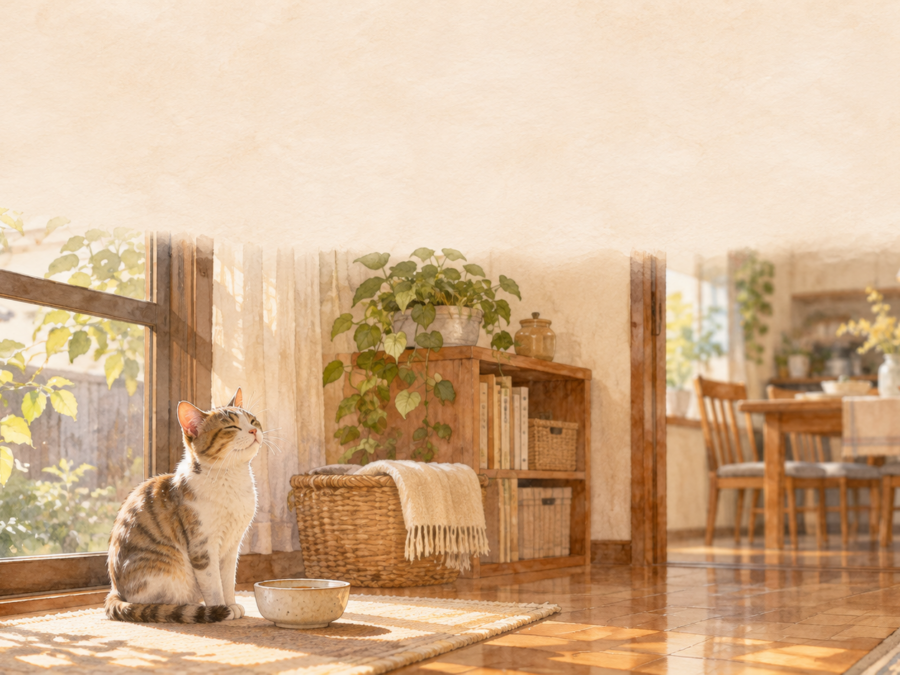
This song was born after my cat Kosuke, who lives with me, suddenly had a seizure, suffering and terrified before my eyes.
If I could take his place, I would do so right now.
I want to take on all of his pain, suffering, and fear myself.
That was the feeling I put into the lyrics.
But as I listened to the song again and again, small memories from the past—ones I had seemed to forget for so long—began to surface.
A family that treated my suffering as if it never existed
In the family I grew up in, my suffering and pain were denied over and over again.
My father in particular refused to acknowledge it, no matter how much I was suffering.
Even when I had a fever close to 40°C from food poisoning, or when I developed an acute internal medical problem serious enough to require an ambulance, he would look at me suffering right in front of him and say things like,
“There’s nothing wrong.”
“There’s no problem.”
“You’re not suffering.”
That was the kind of attitude he took.
He would even smile as if nothing were wrong.
Did he truly not believe me?
Was he unable to understand that I was suffering?
Or did he understand and deny it anyway?
Even now, I do not know what his intentions were.
But it is a fact that the pain I was experiencing right in front of him was repeatedly treated as something that “did not exist.”
In clinical terms, I think there were aspects that overlapped with long-term psychological denial and gaslighting.
When that is repeated from childhood onward, you begin to give up on trying to tell others about your pain.
Even if you say, “I’m suffering,” you are denied.
Even if you say, “It hurts,” no one believes you.
If you ask for help, you might be laughed at.
And so, I became someone who rarely spoke about my own suffering.
(That is why I later processed it by writing it out.)
Even so, my mother did not deny it
But as I listened to “Kawari,” I suddenly remembered.
Come to think of it, my mother was the only one who did not deny my pain.
(At least, there were times when she did not.)
This is not to say that my mother helped me enough.
Nor is it to say that she protected me or stopped the problems in our family.
Even so, at the very least, my mother did not treat the fact that I was sufferingas something that “never happened.”
She saw my pain.
There was a part of her that accepted my suffering for what it was.
And although I do not remember clearly, I think it was when I was suffering badly enough to be taken away by ambulance.
My mother said something like this to me:
“If I could take your place, I would.”
They were almost the exact same words I felt from the bottom of my heart when I looked at Kosuke this time.
The wounds have not disappeared
Remembering this does not make my family’s problems in the past disappear.
It does not change the fact that my family was dysfunctional, that I was hurt, or that I suffered for a long time.
Nor do I want to retell everything about my relationship with my mother as something beautiful.
People are not either completely good or completely bad.
Even within deeply hurtful relationships, small moments of warmth sometimes remain.
Acknowledging them does not mean denying the wounds.
The fact that I was hurt and the small love that truly existed there can coexist.
Until now, I have tried to understand the great suffering that took place within my family.
Perhaps, in that process, I was finally able to pick up again the small words from my mother that had been buried and gone unseen.
What was contained in the word “Kawari”
When I saw Kosuke suffering, I sincerely wanted to take his place.
I wanted all of his pain and fear to be transferred to me.
And by turning that feeling into a song, I feel that, for the first time, I was able to understand from my own side a part of what my mother felt toward me in the past.
I do not know how strongly my mother felt that way at the time.
But,
“If I could take your place, I would.”
Within those words, there was, at the very least, the warmth of someone who had seen my pain.
Something that remained—however small, yet certainly there—within a family filled with denial.
When I remembered it, I felt a quiet warmth deep in my chest.
I think I no longer have to lose sight not only of the memories of being hurt, but also of the small love that was there.
You can listen to “Kawari,” the song I created this time, here.

田舎のネットに、
もうひとつの選択肢。
WiMAXが窓際でやっとだった僕の家。Starlinkに替えた実体験と、導入前の確認ポイントをまとめました。
公式で詳細を見る(紹介リンク・新しいタブで開きます) 実体験と紹介特典を見る紹介リンクから条件を満たして契約すると、筆者に報酬が付与されます。

Related Articles


Conversation
Be the First Voice
読んだだけで終わらせないでください。
感じたことを、コメント・発信・メモなど、何かの形で外に出してみてください。
反応した瞬間から、変化は始まります。
この場所に、最初の感想や気づきをそっと残せます。